Summary: A burner draws its air from the boiler room, and a room that cannot supply enough air produces soot and carbon monoxide (CO), pushes the burner out of tune, and can lose the flame. Combustion and Control Solutions (CCS) explains how combustion air openings are sized, the changes that most often cut a boiler room's air supply, and what to do before the first cold snap.
Key Takeaways:
- The burner manual and local code decide how much opening a boiler room needs.
- Combustion air problems usually follow a change: new equipment, a repurposed room, an upgrade that removes louvers, or a season that shifts the burner's tune.
- A flue-gas analysis during tuning and working CO alarms in the boiler room are an important safeguard to detect troublesome air supply issues.
Boiler Room Combustion Air Requirements Start With the Burner
When considering negative factors on a boiler's systems performance, air supply is often forgotten.
Combustion needs air in volume. Natural gas requires about 10 cubic feet of air for every cubic foot burned, and burners run with extra air on top of that. All of that air comes through the boiler room's louvers, grilles, or ducts. When the room cannot supply that air, the burner produces soot, CO, and, in the worst case, a flame that goes out. The air requirement belongs to the burner, not the boiler.
The Combustion and Control Solutions team works on burners and combustion controls across the Southeast. CCS technicians see all manner of burners, such as Weishaupt, Oilon, Faber, and others.
Combustion Air Problems Show Up When Something Changes
A boiler room that ran fine for years does not start starving for air on its own. CCS technicians usually find a change behind the problem.
Common factors that cause air supply issues:
▪ The season turned. Air properties change with the seasons, and the burner needs combustion tuning to correct for these changes.
▪ New equipment installed into an existing facility, or a room that was repurposed as a boiler room. The original planning never accounted for combustion air causing the equipment to fail.
▪ The facility was upgraded, and louvers were removed, or access doors with built-in louvers were replaced with solid doors.
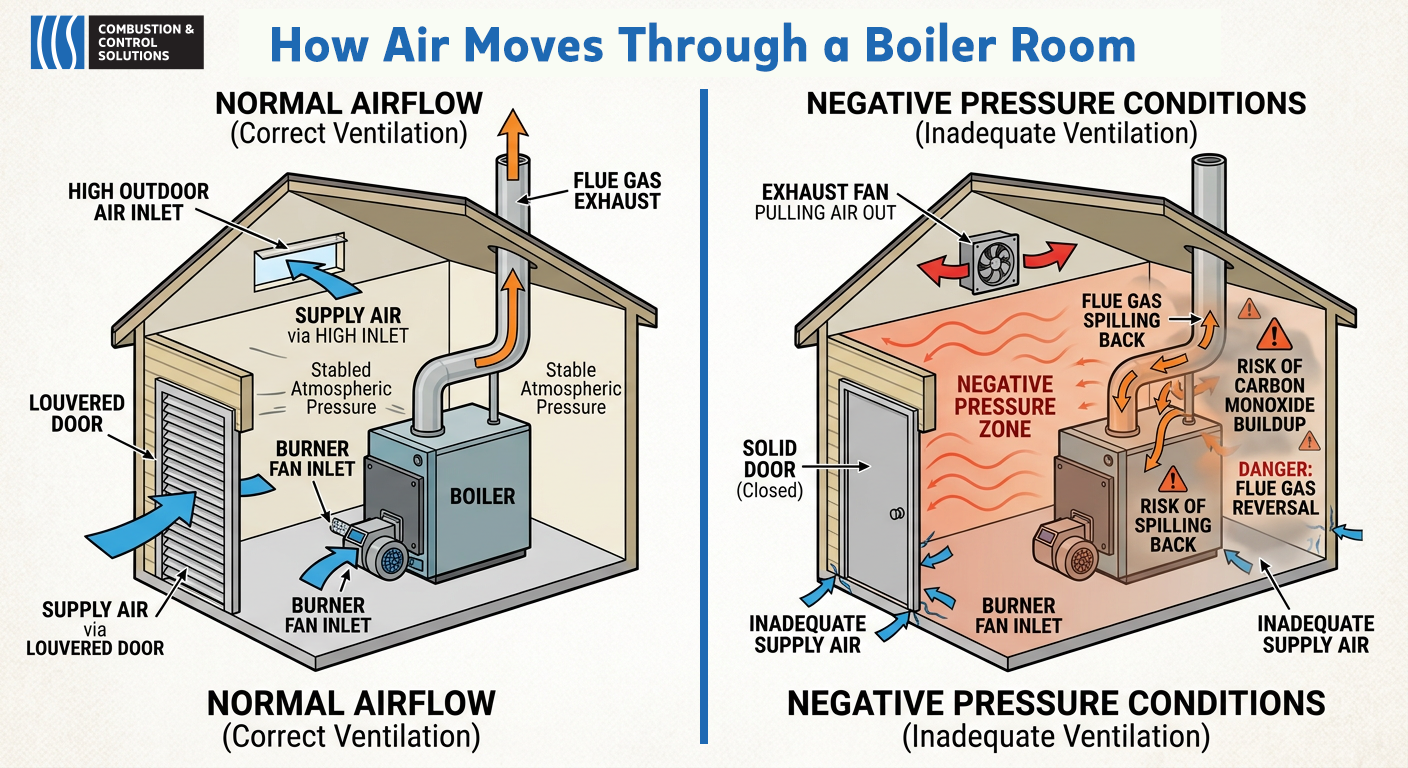
In one particular instance, a CCS technician evaluating a boiler room in Mississippi ran into a problem several other service groups had not solved. The boilers would not run correctly. The cause was the louver doors. The customer had swapped a set of doors that carried fresh air louvers for solid doors, and those louvers were the only source of fresh air to the boiler room. The technician told the customer, and the customer pursued a solution to bring fresh air back into the boiler room.
When air supply problems turn up, it is usually presented as one of two situations. In one, the boiler room has a roll-up door that the customer leaves cracked open for air. In the other, the boiler sits in the middle of the building, and getting fresh air to the boiler takes deeper planning.
The Burner's Manual and the Code Set the Opening Size
A confined boiler room needs permanent openings to the outdoors, one high and one low. For boilers with power burners, the model fuel gas code points back to the manufacturer's installation instructions, so the burner manual is the first place to look. Additionally, local code requirements vary across Tennessee, Georgia, Alabama, Mississippi, and North Florida. Together the burner manual and the local code official decide the applicable method, so check both before changing a louver.
Our team of technicians at CCS can perform a flue-gas analysis to assess the air flow needs for your specific configuration.
Air Starvation Leaves Clues Before the Flame Goes Out
There are a few early warning signs that your system is starved for air. Catching these preliminary signs can prevent a total shut down. Sometimes the fire starts to smoke or the combustion is incomplete. Maybe your CO monitors show a higher reading than usual. The most obvious sign is that the flame goes out. The goal is to catch the issue before this stage. The earlier signs are the ones to catch.
Here are a few signs the room is short on air:
▪ Soot building up on the burner, in the tubes, or at the stack
▪ High CO on a combustion analyzer. A room short on air can build CO before anyone sees a problem. Keep CO alarms working in and around the boiler room.
▪ Doors that slam shut or are hard to open, because the room is under negative pressure
▪ Flue gas spilling back into the room
▪ Flame loss, the late sign, and one that can arrive before the safety system reacts
An easy preliminary field check your team can perform is to open an exterior door with the boiler firing. If air rushes in and the door slams shut on its own, the room is pulling air from a source other than its louvers. If this is the case, contact our team to come perform a thorough analysis for air flow direction and amount. Our technicians at CCS can help identify the specific air flow issues and suggest solutions to fit your particular set of needs.
Building Changes Take Air Away From the Burner
Buildings constantly change as they age. Updates and renovations can dramatically affect your boiler system's air flow that was designed at the point of installation. Some common examples of building changes that affect airflow are a new process exhaust fan, a spray booth or kitchen hood near the boiler room, or a vent fan in the boiler room. Again, doors slamming shut is a clue the building has gone under negative pressure.
Additionally, a draft hood or barometric damper pulls room air as well as a stack damper that does not open fully, clogged fan inlet screens, or dirty fan blades add restriction to the air path. Each one is worth a look when a technician evaluates the room.
A Cold Snap Tempts People to Close Louvers and Shifts the Burner's Tune
A louver is an open hole in a wall, and in January the hole is cold. CCS has been on calls during cold snaps where the customer closed off the louvers altogether. Closed louvers starve the burner, and that leads to the sequence above: smoke, CO, flame loss.
It is also possible that the burner drifted well outside its tune because of the severity of the cold air. Cold air is denser and carries more oxygen into every cubic foot the burner fan delivers, so the fuel-to-air ratio shifts as the weather turns. Heat the incoming air instead, keep the air at 50 degrees Fahrenheit (10 degrees Celsius) or warmer at the burner fan inlet, and follow the burner maker's limits. Any motorized louver must be proven open before the burner is allowed to fire.
A seasonal tuning visit from CCS corrects for this yearly weather shift.
A Flue-Gas Reading Settles What the Flame Cannot
A flame can look fine and still be starved. CCS technicians use Testo combustion analyzers on tune-ups and preventative maintenance visits. A flue-gas analysis reads oxygen or carbon dioxide and CO in parts per million, the readings show whether the fuel-to-air ratio has moved. Our team's focus is testing the system itself. Working CO alarms in the boiler room are vitally important to keep tabs on the ambient presence of CO.
CCS Technicians Look at Where the Air Comes From
Combustion and Control Solutions services burners and combustion controls for plants across Tennessee, Georgia, Alabama, Mississippi, and North Florida. When a CCS technician evaluates a boiler room, the look includes where fresh air is supposed to come from and what has changed since the room was built. When the fix sits outside the boiler room, such as a louvered door replaced with a solid one, the technician can show the customer specifically where the air supply is hampered.
Helpful Information needed at the time an evaluation with a CCS technician:
▪ The burner make and model, and the boiler's rated horsepower or fuel input
▪ Doors, louvers, or exhaust fans changed or added since the boiler room was built
▪ Any history of CO alarms, soot, or doors slamming near the boiler room
▪ The most recent combustion analysis or tune-up report, if one exists
If air supply is in question, talk to CCS about evaluating your boiler room ahead of the first hard freeze.
Frequently Asked Questions (FAQ)
How much combustion air does a boiler need?
Natural gas needs about 10 cubic feet of air per cubic foot burned, and the burner's manual states its own air requirement.
How do you size combustion air openings for a boiler room?
Divide the total CFM by the allowed velocity. For example, one major manufacturer limits openings below 7 feet to 250 feet per minute and openings above 7 feet to 500. The result is the required net free area, so use the louver maker's rated free area.
What is the difference between combustion air and ventilation air?
Combustion air feeds the flame and mixes with fuel in the burner. Ventilation air carries heat off the boiler jacket and equipment and keeps the room workable.
What happens if a boiler does not get enough combustion air?
Combustion becomes incomplete. The flame smokes, soot builds up, CO is produced, and the flame can go out.
Do I need make-up air for a boiler?
Yes, when exhaust fans or other equipment pull air out of the building faster than it comes in. The model fuel gas code calls for make-up air where exhaust fans interfere with appliance operation. Local adoption varies, so confirm with the local code official.
How do I know if my boiler room is under negative pressure?
Common signs include doors that slam shut or are hard to open, flue gas spilling into the room, and CO or soot that was not present before. Working CO alarms in the boiler room add a layer of protection.
Does a boiler need to be re-tuned when the seasons change?
Often, yes. Air properties shift with the seasons, and a burner can drift out of tune, especially in a cold snap. A CCS combustion analysis shows whether the fuel-to-air ratio has moved and where to adjust.
Can I close the combustion air louver in winter?
No. Closed louvers starve the burner. Instead, heat the incoming air to at least 50 degrees Fahrenheit (10 degrees Celsius). Any motorized louver must be proven open before the burner fires.
Can I use an exhaust fan in a boiler room?
Generally no. Some boiler manuals do not recommend them because they upset combustion air. Where ventilation is needed, it should be engineered and acceptable to the local code official.
How much does it cost to fix boiler room combustion air?
Cost depends on how much opening area is missing, whether louvers are fixed or motorized, and whether ducting or air heating is needed. Replacing a louvered door is a very different job from planning fresh air for an interior boiler room. A site evaluation sets the scope before pricing.