
Summary: Combustion and Control Solutions (CCS) walks facility teams through how inspection frequency, certificate renewal windows, and qualified inspector rules differ across Tennessee, Georgia, Alabama, Mississippi, and North Florida.
Key Takeaways:
- Inspection frequency, certificate renewal windows, and inspector qualifications all vary by state and boiler type.
- Because of the differences in inspection rules, a facility running plants in multiple Southeastern states juggles multiple compliance calendars on different timelines.
- CCS preps facilities for inspection by matching the right agency, inspector type, and renewal window to the state a plant sits in.
Five States, Five Different Boiler Programs
A power boiler in Chattanooga, Tennessee and a power boiler in Atlanta, Georgia can carry the same nameplate but sit on different inspection schedules, filed with different agencies, under different renewal rules. Facility teams running plants across the Southeast are challenged with coordinating facilities under the same corporate name operating under different state regulations.
Combustion and Control Solutions (CCS) works across Tennessee, Georgia, Alabama, Mississippi, and North Florida. Five states, five boiler programs, with notable differences state to state.
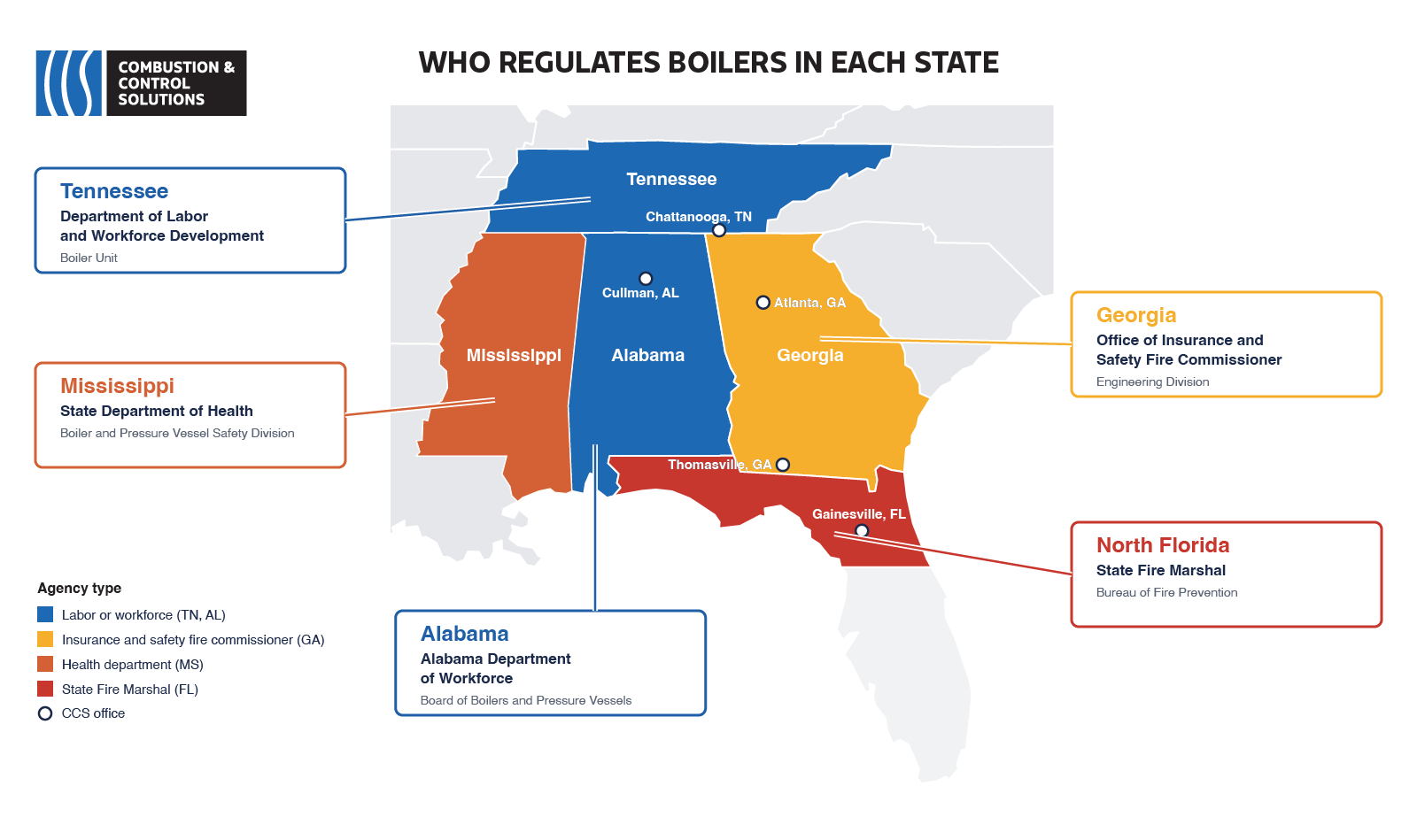
Two of the five states, Tennessee and Alabama, place boilers within a labor or workforce agency. Georgia uses its Insurance and Safety Fire Commissioner, Mississippi uses its Health Department, and Florida uses its State Fire Marshal.
These state by state distinctions affect day to day business for companies operating in multiple jurisdictions. A facility team in the habit of contacting the Labor Department for a Tennessee boiler question will need to contact a different office entirely in Georgia, Mississippi, or Florida, whether that is an Insurance Commissioner, a Health Department, or a Fire Marshal.
State boiler codes may be amended from time to time. The requirements below reflect each state's rules as of this writing (October 2026). Each state's program page, statute, and rules are linked at the bottom of this blog post so you can confirm the current code before scheduling an inspection. CCS technicians can assist your team in parsing through this information. Contact our team to discuss your specific needs.
Inspection Frequency By Southeastern State
Every state in the region inspects power boilers on some annual or near-annual cycle. The details within a state's inspection vary.
▪ Tennessee. Power boilers are inspected annually, both internally and externally while not under pressure, with an external inspection under pressure about six months after each internal inspection. Low-pressure heating boilers are inspected biennially, internally and externally where construction permits. Unfired pressure vessels prone to internal corrosion are inspected every two years. The state's board can grant a variance for longer intervals, but a boiler under variance needs an external inspection under pressure every six months.
▪ Georgia. Power boilers and high-pressure, high-temperature water boilers get an annual certificate inspection. Low-pressure steam or vapor boilers and hot water heating and supply boilers move to biennial. Pressure vessels move to a three-year cycle, with an internal inspection at the inspector's discretion. Georgia also allows extended intervals, up to 24 months for power boilers and 18 months for black liquor boilers, with approval from the Office of Insurance and Safety Fire Commissioner, a detail that impacts the region's paper and pulp plants.
▪ Alabama. Power boilers and high-pressure, high-temperature water boilers get an annual certificate inspection, internal where construction permits, plus an external inspection under pressure when feasible. Low-pressure steam or vapor heating boilers move to biennial with an internal inspection every four years where construction permits. Hot water heating and supply boilers and pressure vessels are biennial, with internal inspection at the inspector's discretion.
▪ Mississippi. Power boilers and high-pressure, high-temperature water boilers get an annual certificate inspection, plus an annual external inspection under pressure if possible. Heating boilers are inspected biennially, as are pressure vessels subject to internal corrosion. Certificate inspections also carry a two-month grace period beyond the specified interval, and the state's board can permit longer intervals.
▪ Florida. Public assembly boilers must be inspected within 30 days after the certificate of operation expires. Hot water boilers are biennial, with an internal inspection every four years.
CCS technicians track which clock applies to which unit well before an inspection date arrives. By keeping up with the nuances from state to state, our team helps prevent expensive delays and missed inspection deadlines.
Certificate Renewal Windows
A facility team that plans its documentation cycle around one state's rhythm and then opens a second site in a different state is not just adjusting a date. The whole planning cadence changes.
Georgia inspects pressure vessels on a three-year cycle, while Tennessee, Alabama, and Mississippi set theirs at two years. Georgia also lets qualifying operators stretch power boiler internal inspections to 24 months, and Tennessee's board can grant variances for longer intervals with more frequent external checks.
Grace periods differ as well. Mississippi allows a two-month grace period beyond the specified interval, and Tennessee allows a two-month extension to its 12-month inspection cycle. Georgia sets no automatic grace period, though the Commissioner can extend a permit on written request. Boilers more than six months overdue can be inspected by the state and invoiced a special inspection fee on top of standard fees. Alabama's inspection rule does not mention one, and Florida's public assembly rule expects an inspection within 30 days after the certificate of operation expires.
A facility that assumes every state offers the same buffer past a renewal date is planning against a cushion that may not exist in another location.
Qualified Inspector Rules by State
Several states in the region accept Commissioned Insurance Company Inspectors alongside State Deputy Inspectors. However, paperwork requirements to document an inspection vary state to state.
- Tennessee requires inspections to be made by the chief inspector, a deputy inspector, or a special inspector.
- Georgia's Commissioner, Chief Inspector, or any deputy inspector retains standing access to inspect boilers on-site during reasonable hours, no matter what inspector type last certified the unit. Georgia also requires repair facilities to send the Chief Inspector a copy of the completed R-1 repair form, signed by the inspector, within 30 days of a welded repair.
- Alabama allows certificate inspections by the chief inspector, deputy inspectors, special inspectors who hold an Alabama certificate of competency and work for an insurance company, and owner/user inspectors employed by companies operating pressure vessels in the state.
- Mississippi's Department of Health states that state and private inspectors conduct its inspections.
- Florida uses special boiler inspectors for insured boilers, and for boilers in public assembly locations inspectors must file a written report with the chief boiler inspector within 15 days after each certificate inspection.
CCS will help navigate your boiler requirements
A facility manager transferring between two Southeastern states does not want to learn of a documentation gap in front of an inspector standing in the boiler room. CCS technicians work across jurisdictions in Tennessee, Georgia, Alabama, Mississippi, and North Florida. The documentation habits that satisfy one state's filing requirement do not always satisfy another's.
Our team preps plants for inspection with that distinction built in: current operating certificates, prior inspection reports, safety valve and low-water cutoff test logs, and any R-stamp repair documentation, organized to match what the specific state inspector expects to see.
Once the inspection takes place, CCS can handle any adjustments that result and keep the paperwork filing on track. If an inspection turns up a pressure vessel finding that needs code work, that repair stays with the same team instead of routing to a second contractor unfamiliar with the state's filing process. CCS's in-house ASME S, ASME U, and National Board R stamp credentials cover that repair.
A prep visit ahead of an inspection date typically confirms:
▪ Which agency the site reports to
▪ Whether the state's inspector type on file (state deputy or insurance special inspector) matches what that state requires
▪ How much runway the certificate's renewal window and any grace period leave before a lapse becomes a problem
Getting those three answers right before the inspector arrives is most of what separates a routine visit from a scramble. Call CCS to schedule a prep visit before that date is on the calendar.
Booking Ahead of the Fall Queue
Fall tends to be the busiest booking window for jurisdictional inspections across most of the Southeast. A plant on an annual Tennessee or Mississippi cycle competing for an October inspection slot is in a very different position than a plant holding an approved 24-month internal inspection interval in Georgia.
Confirming how a state's clock applies to each site on a multi-state footprint, and how much time the state's grace period allows, is worth doing before the queue fills rather than after a certificate lapses.
Current Boiler Regulation Links by State
State boiler codes are subject to change. Always confirm your state's current codes and regulations. See links by state below.
- Tennessee. The Boiler Unit sits inside the Department of Labor and Workforce Development. Statute: Tenn. Code Ann. Title 68, Chapter 122 (inspection requirements at § 68-122-110). Rules: Tenn. Comp. R. & Regs. 0800-03-03.
- Georgia. The boiler program is regulated by the Engineering Division of the Office of Insurance and Safety Fire Commissioner. Statute: O.C.G.A. Title 25, Chapter 15, Article 2. Rules: Georgia Rule 120-3-26.
- Alabama. The Alabama Department of Workforce administers the program, with rulemaking by the Board of Boilers and Pressure Vessels. Statute: Boiler and Pressure Vessel Safety Act, Code of Alabama 1975, Title 25, Chapter 12. Rules: Alabama Administrative Code Chapter 480-7-5.
- Mississippi. The Boiler and Pressure Vessel Safety Division of the Mississippi State Department of Health runs the program under the Boiler and Pressure Vessel Safety Act of 1974. Statute: Mississippi Code Title 45, Chapter 23 (inspection requirements at § 45-23-33). Rules: Boiler and Pressure Vessel Safety Act, Rules and Regulations.
- Florida. The Bureau of Fire Prevention within the Division of State Fire Marshal runs the Boiler Safety program under the Boiler Safety Act. Statute: Chapter 554, Florida Statutes. Rules: Florida Administrative Code 69A-51.
Frequently Asked Questions (FAQ)
How often does a boiler need to be inspected in the Southeast?
Frequency depends on the state and boiler type. Power boilers require an annual certificate inspection in Tennessee, Georgia, Alabama, and Mississippi, and in Florida for boilers in public assembly locations. Heating and hot water boilers commonly move to a biennial cycle.
Which Southeast state allows the longest boiler inspection intervals?
Georgia's pressure vessel cycle is three years, the longest standard interval among these five states, and Georgia can approve 24-month internal intervals for qualifying power boilers. Tennessee's board can also grant variances for longer intervals with added external inspections.
Which agencies regulate boilers in the Southeast?
The regulating agency varies by state. Tennessee uses its Department of Labor and Workforce Development, Alabama its Department of Workforce, Georgia its Office of Insurance and Safety Fire Commissioner, Mississippi its State Department of Health, and Florida its State Fire Marshal.
Do insurance company inspectors count the same as state inspectors in every state?
Not exactly the same way. Tennessee, Alabama, and Florida name insurance company special inspectors in their rules, but filing requirements differ. Florida, for example, requires a written report to the chief boiler inspector within 15 days of a public assembly certificate inspection.
What happens if a boiler certificate lapses before the next inspection?
Consequences vary by state. Mississippi and Tennessee allow a two-month grace period or extension. Georgia can invoice a special inspection fee when a boiler is more than six months overdue. Florida requires public assembly boilers to be inspected within 30 days after the certificate expires.
Are boiler inspection requirements different for hospitals and schools than for industrial plants?
In some states, yes. Florida applies its public assembly inspection rule to boilers in places such as schools and hospitals, requiring inspection within 30 days after the certificate of operation expires.
Does a multi-state facility need a different compliance plan for each site?
Effectively, yes. Inspection frequency, certificate renewal windows, and qualified inspector rules all vary by state. A compliance calendar built around one state's rhythm will not correctly track a site in a different state without adjustment, since the consequences of a lapsed certificate change from one state to the next.
When is the busiest season for jurisdictional boiler inspections in the Southeast?
Fall tends to be the busiest booking window across most of this footprint, as facilities work to complete inspections before the heating season ramps up. States running shorter renewal cycles tend to feel that queue pressure earliest.